Our Approach to ensuring we are a responsible business
Conducting business honestly and ethically is a core pillar of our corporate identity which is facilitated by a strong corporate governance framework of appropriate systems, policies, and procedures.
Q1 2026 Highlights
63%
Directors considered to be Independent
2025: 63%
38%
Women on the Board
2025: 38%
Responsibility focus areas
Respecting human rights
We are deeply committed to protecting and upholding human rights across the organisation and our value chain. Human rights compliance and ethical business conduct are overseen at a Board level by the Sustainability Committee, with management-level responsibility held by the Corporate Sustainability Director.
Our Human Rights Policy is aligned with the Universal Declaration of Human Rights, the UN Guiding Principles, the UN Global Compact, and the ILO core conventions. It sets out standards expected of our employees, suppliers, and contractors and outlines how we integrate human rights considerations into business practices.
In 2025, we published our first Modern Slavery Statement, which highlights our human rights policies, due diligence processes for business partners, grievance mechanisms, and our risk assessment and management procedures. We plan to update our Modern Slavery Statement every two years. Year to date, we also undertook a gap assessment and leadership training on human rights with third-party specialists.
Code of conduct
Our Board ensures that our values are reflected in our business conduct and activities, as set out in our Code of Conduct and supporting policies. The Code applies to all people acting for or on behalf of Hochschild and is made available to employees, contractors, and suppliers through internal channels and on our website in English, Spanish, and Portuguese. It is periodically reviewed to ensure its continued relevance, with the latest update completed in 2025. Any breach of the Code is considered serious misconduct and will result in appropriate disciplinary action.
The Code of Conduct sets out expected behaviours relating to fair business dealings, compliance with laws, conflicts of interest, professional ethics and transparency, prioritisation of health and safety, responsible environmental and community practices, and confidentiality.
Compliance with the Code of Conduct and related policies is sought through a number of initiatives, such as the HOC Compliance Podcast in Brazil, the Internal Legal and Compliance Portal, and constant training for all staff on the Company's policies and values.
Our Anti-Bribery & Corruption and Anti-Fraud Policies complement the Code and are supported by the Prevention and Criminal Compliance Manual and the Policy on Interaction with Public Officials. All operations have been assessed for corruption-related risks in compliance with this manual, and all Hochschild employees receive regular training sessions on these policies.
Whistleblowing
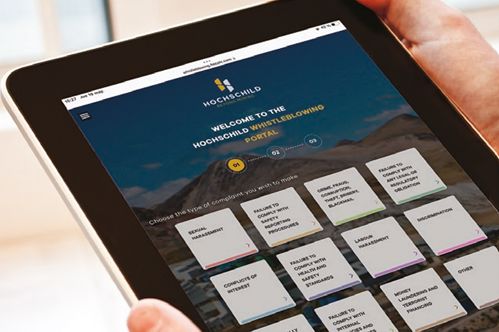
Our Whistleblowing Policy, reviewed annually by the Audit Committee, is facilitated by an online portal that allows anyone to report concerns, anonymously or otherwise. All submissions are automatically distributed to a designated group – including the Chair of the Audit Committee, the Vice President of People and Corporate Affairs, and the Company Secretary – and are subsequently investigated by the Internal Audit department, which determines appropriate actions and provides quarterly updates to the Audit Committee.
We take all legitimate reports seriously and enforce a zero-tolerance policy against retaliation, maintaining strict confidentiality regarding complaints received and the identity of whistleblowers. While contact information is encouraged to enable effective follow-up and full investigation, it is by no means mandatory.
Find our Whistleblowing portal here.
Mitigating risks and negative impacts
The management of our operations and execution of our growth strategy are subject to a number of risks which, if realised, could adversely affect performance. Our risk management framework relies on continuous monitoring of the environment, the risks posed by it, and the evaluation of potential mitigation actions, all aligned with the COSO framework and regularly monitored by the Risk Committee.
We conduct risk assessments across all current and potential operations, addressing areas such as corruption, labour standards, human rights, health and safety, and environmental concerns. We are also committed to remediating any negative environmental and social impacts we may cause or contribute to, as outlined in the environmental impact assessments and management plans approved by the relevant authorities. We perform baseline studies, continuous environmental monitoring, and community consultations to identify and mitigate potential impacts.
Responsible Supply Chain Management
We work closely with our suppliers to ensure that we are part of a value chain that respects human rights and promotes sustainable outcomes. For this reason, compliance with our Supplier Code of Conduct is required of all suppliers. Among other subjects, it outlines workers’ rights to freedom of association; fair wages, hours, and weekly rest; and job security.
All new suppliers undergo a centralised assessment that goes beyond commercial and financial position to include exposure to corruption, bribery, and collusion. All supplier contracts also require alignment with our ESG standards, including the implementation of OHS and Environmental Management Systems, prioritisation of local employment and procurement, compliance with human rights and anti-corruption regulations, and the safe and compliant operation of equipment.
Supply chain risks are identified and addressed through continuous monitoring of critical suppliers’ capacity to supply the relevant goods and monitoring of compliance with safety, environmental, and social contractual agreements; and the ability to report supply chain concerns through the Whistleblowing portal. Contracts allow for immediate termination for breaches of the Code of Conduct and financial penalties for safety or environmental non-compliance, with the right to immediate termination for material violations.
Advocacy for Positive Change
We engage proactively with policymakers, professionals, and civil society to discuss, review, and approve proposed initiatives targeted specifically at the mining industry and other measures that could impact Hochschild, such as climate change-related regulation.
In our commitment to promoting ESG guidelines and practices within the mining industry, we play a key role in industry associations and professional forums such as the Sociedad de Minería, Petróleo y Energía (SNMPE) in Peru, Cámara Argentina de Empresarios Mineros (CAEM) in Argentina, and Instituto Brasileiro de Mineração (IBRAM) in Brazil.
Additionally, we are active members of the United Nations Global Compact, the world's largest corporate sustainability initiative. As such, we commit to integrating the United Nations' ten principles on human rights, labour, environment, and anti-corruption into our overall ESG approach and reporting the Company's annual progress towards the Sustainable Development Goals (SDGs).
Materiality Assessment
Refining our materiality
We periodically undertake a sustainability materiality assessment update. This enables us to identify and report on the sustainability topics that (i) Hochschild has the potential to have a social or environmental impact on, and (ii) may create financial risks or opportunities for our business.
We plan to undertake a materiality update every two years. This timeframe ensures that our material topics reflect changes in our business and in the wider external environment, including regulatory developments.
Defining material topics
The three-step process to identify material issues consists of:
- Identifying potentially material topics through desk-based research of sustainability standards and frameworks, and the emerging trends in the industry.
- Refining topics through internal and external stakeholder engagement, completed through interviews and surveys.
- Scoring and prioritising topics according to the financial and impact materiality.
Materiality Assessment Results
Our last materiality assessment was performed in 2024. It highlighted six topics as being of ‘very high priority’:
- Positively impacting local communities and supporting socio-economic development;
- Water management;
- Climate change resilience;
- Occupational health and safety;
- Biodiversity and ecosystem services; and
- Management of waste and tailings.
ESG Ratings
Our performance in environmental, social and governance matters ("ESG") is ranked or scored by a number of organisations including the following:
- CDP - Climate Disclosure Project: a global disclosure system supporting organisations in managing their environmental impacts resulting in scores ranging from A to D-.
- Morningstar Sustainalytics ESG Risk Rating: measures the degree to which a company's valuation is exposed to unmanaged ESG risks. Ratings are given on the following scale: 0-9.99 Negligible, 10-19.99 Low, 20-29.99 Medium, 30-39.99 High, 40+ Severe.
- MSCI: measures the management of financially relevant ESG risks and opportunities. Ratings range from leader (AAA, AA), average (A, BBB, BB) to laggard (B, CCC).
- FTSE Russell ESG Rating: allows investors to understand a company's exposure to, and management of, ESG issues in multiple dimensions. Ratings range from 0 to 5 to 1 decimal point (5 being the highest rating).
| Organisation/index | Last Update |
Score
|
|---|---|---|
| CDP (Climate) | Mar 2026 | B |
| CDP (Water) | Mar 2026 | B |
| Sustainalytics | Sep 2025 | 26.8 |
| MSCI | Mar 2026 | AA |
| FTSE | Dec 2024 | 3.8 |
Contribution to the SDGs